Our habitat projects the students made at home.
Showing posts with label science. Show all posts
January 8, 2012
Force and Motion
All of my force and motion lessons and stations came from AIMS. You
can order these activities for $2 at their website.
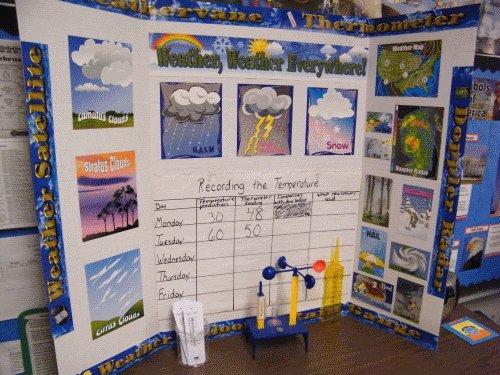
Weather
I like to make portable bulletin boards to use year after year.
We went outside to observe the weather with our senses.
Skeleton
Students made a t-chart in their Science journal.
The students were scared of my skeleton hanging up in the
Science center. They wanted to know if it was real.
Plants
Students brought seeds from home. We compared the seeds and the
students taped three seeds in their journal and described the seeds.
I put the students in groups of three and gave each group the same kind of
seed. Each group got 3 cups with potting soil, playground soil, and sand. Then
they had to record their results in their Science journal.
Students labeled the parts of a plant.
November 6, 2011
September 10, 2011
Teaching the Scientific Method with Popcorn
1. Question: (Start off with a question): Does popcorn sink or float in water?
2. Hypothesis: (Make a guess and tell why you made that guess):
Examples- I think it will float because it is popped in air. I think it will sink because it has
holes in it.
3. Procedure (What are the steps for your experiment?):
1. Research Popcorn (internet, read “The Popcorn Book” by Tomie dePaola)
2. Pop popcorn (2 bags for the class)
3. I cup of water for two students
4. Each student drops 2 pieces of popcorn in the cup of water.
4. Data. (graph, t-chart, picture, drawing, venn diagrams, ):Draw your results in your Science journal.
5. Results/Conclusion (Record you final results and thoughts): Popcorn floats in water. After I put the popcorn in water, it stayed on top and didn't sink. Explain to the students that the flakes float because they are lighter or less dense than the water, and the kernels sink because they are denser or heavier than the water.
Extra: Do the kernels sink or float?
Scientific Posters
Scientific Poster
I laminated the posters and as we are doing the experiment, I write down the process on the posters.
Teaching Hypothesis
What is a Hypothesis?
If I leave an ice cube in the sun, will it melt?
This is a good prediction. In science, we call it a hypothesis.
A hypothesis tells what you think will happen and why.
What makes a good hypothesis?
- It is a statement.
- It tells what you think will happen and why.
- It can be tested.
Scientific Method
This is one of my favorite things in the world to teach. I use a popcorn to teach this lesson and the students love it. I will post that lesson in a later post.
1. Question: What do you want to learn about the topic?
2. Hypothesis: You make a prediction to answer your question.
3. Procedure: Write each step you are going to take to do the experiment.
4. Data: Is the information you get from the data.
5.Conclusion: Was your hypothesis correct? Why?
Don’t forget to teach the students how to research their topic.
1. Question: What do you want to learn about the topic?
2. Hypothesis: You make a prediction to answer your question.
3. Procedure: Write each step you are going to take to do the experiment.
4. Data: Is the information you get from the data.
5.Conclusion: Was your hypothesis correct? Why?
Don’t forget to teach the students how to research their topic.
Intro to Science Journal with Spiderwick
I let the students decorate their Science Journals with stickers that I purchased from Oriental Trading. Here is my Science Journal lesson.
Science Tubs
I have all my lessons to Science, Social Studies and holidays organized into tubs. It makes it a lot easier for me to just grab the tub with everything already in it.
Subscribe to:
Posts (Atom)